

You don't need a content team to publish content that converts. To start a user-generated content strategy, you need 10 customers willing to say something specific about your product.
A user-generated content strategy is a repeatable system for prompting, collecting, permissioning, and distributing content your customers create about your product — reviews, screenshots, LinkedIn posts, community threads, and video clips. For startups, it's the cheapest way to close the credibility gap against competitors with 50x your budget.
Two bits of context before we get tactical:
The UGC platform market was valued at $9.6B in 2025, is projected at $12.3B in 2026, and $55.0B by 2033.[4] UGC also lands on the list of top marketing trends for 2026.[5]
Consumers find UGC 9.8x more impactful than influencer content, and 79% say it strongly influences what they buy.[6]
Most UGC guides are written for brands that already have thousands of customers.[1][3] This one solves the cold-start problem: what to do when you have 10 users, or none. You'll get a stage-based flywheel, a B2B/SaaS playbook, a low-cost tool stack, a rights workflow, and KPI milestones you can hit this quarter.
1. The Financial Case: What a User-Generated Content Strategy Does to Startup Metrics
Skip the "trust is important" speech. Founders decide on numbers, so here they are.[2]
154% higher revenue per visitor when UGC is featured on-site.
50% lower CPC and 4x higher CTR on ads using customer content.
45% conversion lift from the first 10 product reviews.
40% of shoppers won't buy at all if a product page has no UGC.
3x conversions when social content is combined with ratings and reviews, in Bazaarvoice client data.
Now do the math on your own numbers. A 50% CPC reduction on a $2,000/month ad budget is the same as doubling spend — without raising a round, hiring a media buyer, or diluting your cap table. That's why UGC hits startups harder than enterprises: the enterprise gets a nicer quarter, you get runway.
1.1 The Trust Gap Startups Can Exploit
There's a wide gap between how brands see themselves and how buyers see them. 92% of marketers believe they create authentic content, but only 51% of consumers think their favorite brands are authentic — and 60% of consumers say UGC is the most authentic content format.[6]
"47% of shoppers say user reviews on retailer websites are the most influential content when researching products online. Brand-generated social content? Just 11%. Influencer posts? Only 10%." — Hootsuite, Complete guide to user-generated content (UGC) in 2026[3]
Read that as arbitrage. Your competitor's polished campaign sits in the 11% bucket. Your 25 detailed customer reviews sit in the 47% bucket. An unknown startup with real reviews can out-convert a known brand with a beautiful ad.
1.2 The SEO Angle Most UGC Guides Skip
UGC isn't only conversion fuel — it's indexable content you didn't have to write. 25% of search results for the world's biggest brands are links to user-generated content, and 63% of companies rely on ratings and reviews to hit their SEO goals.[2] Small businesses see the same pattern: UGC builds trust, search visibility, and inbound leads at once.[8]
The mechanics for a startup:
Review pages on G2, Capterra, or Product Hunt rank for "[competitor] alternative" queries.
Reddit and community threads surface for long-tail problem searches.
Comparison posts written by users catch buyers at the decision stage.
Directory and ranking listings create third-party pages that point back to you.
That last one is what founders leave on the table. Mentions only compound if they're linked and discoverable, which is why a startup ranking and directory profile with do-follow links belongs in the same plan as your review collection — it turns scattered mentions into measurable link equity while customers build the social proof.
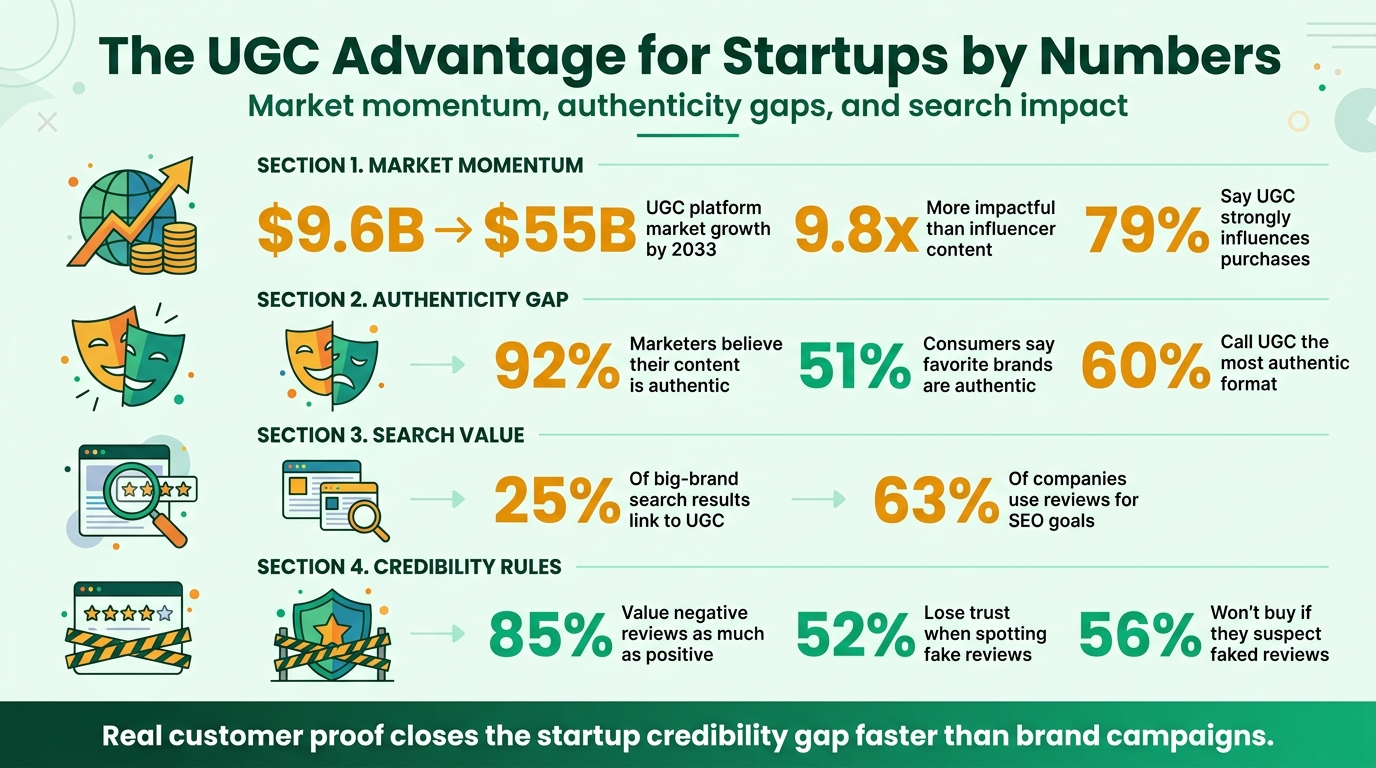
User-Generated Content Impact Statistics for Startups
2. The Startup UGC Flywheel: Your User-Generated Content Strategy by Stage
Four stages, one primary goal each. Most startup UGC programs stall because founders copy stage-four tactics — hashtag campaigns, community walls — while sitting at stage one. Skipping stages is the failure mode.
Stage | Primary Goal | Core Tactics | Realistic Output |
|---|---|---|---|
Pre-launch (0 customers) | Manufacture proof from participants | Build-in-public posts, beta tester write-ups, co-creation voting | 3–5 founder-sourced testimonials |
First 10 customers | Systematize the ask | Trigger-based requests, scripted one-line asks | 10 reviews on one platform |
First 100 customers | Build distribution loops | UGC on pricing pages, paid social creative, lifecycle email | 25+ usable assets, 1 UGC ad set |
Scale | Turn advocates into an engine | Advocate group, co-marketing, centralized asset library | 100+ tagged posts per quarter |
2.1 Pre-Launch and Zero Customers: Manufacture Proof from Participants
You have no customers, but you do have participants: beta testers, waitlist signups, people replying to your build-in-public threads.
Post in public and ask for replies, not likes. Share a screenshot of a rough feature and ask testers to post theirs.
Let users vote on the roadmap. Lego's Ideas community is the reference case for turning users into co-creators and free product research.[3]
Use paid UGC creators sparingly — only to fill the gap while organic supply is literally zero.[3]
Concrete move: ask every beta tester one written question — "What did you use before us, and what changed?" Those answers are your first asset library.
2.2 First 10 Customers: Systematize the Ask
Don't ask at onboarding. Ask at the first successful outcome inside the product — first report generated, first payment received, first integration connected. That's when the customer has something true to say.
Then script it. One sentence, one format, one platform:
"You just hit your first 100 tracked links — would you drop a two-line review on G2? Takes 90 seconds."
Milestone: 10 reviews on a single platform. Don't spread them across five sites. Concentration is what produces that early conversion lift.
2.3 First 100 Customers: Build Distribution Loops
Now stop collecting and start recycling. 50% of marketers use UGC in email and 58% in ad campaigns[6] — most startups use it only on the homepage.
Put customer quotes on the pricing page, where hesitation actually happens.
Run UGC creative against brand creative in paid social and compare CPC.
Drop real customer screenshots into onboarding and lifecycle emails.
Add a branded hashtag or public customer wall, plus an approval step before anything goes live.[1]
2.4 Scale: Turn Advocates into a Referral and Community Engine
Some customers will contribute twice. Name that group and give it early access, co-marketing slots, or affiliate incentives — contributors tend to be higher-loyalty, higher-lifetime-value customers.[1]
Then centralize. Adobe's advice is to pull UGC into a CMS and deploy it across every property[1] — for a startup, that means one Airtable or Notion table feeding your site, not six Slack DMs and a folder called "testimonials_final_v3".
3. B2B and SaaS UGC: What Works When Customers Won't Post Selfies
Nearly every UGC guide assumes D2C and physical products. B2B is different: fewer contributors, higher-value assets, and procurement or NDA constraints in the way.
Formats that work:
LinkedIn posts by users — the B2B equivalent of an unboxing video.
Review-site profiles (G2, Capterra, Product Hunt) — high purchase intent, lasting SEO value.
Customer-written case studies — let them publish it on their blog too.
Slack or Discord threads where users answer each other.
Template and workflow sharing — a customer's spreadsheet built on your product counts.
The "my client can't be named" problem has three fixes: anonymized attribution ("Head of Growth, Series A fintech"), metrics-only quotes with no company name, or routing approval through the customer's marketing team instead of legal.
One customer interview should never produce one asset. Turn it into a case study, three social quotes, a comparison-page section, and an SEO article. With no writer on the team, automated SEO article tools like AutoRankr can hold the publishing cadence around those customer stories so the interview keeps working after week one.
4. The Startup UGC Tool Stack and Rights Management Without a Legal Team
You don't need an enterprise platform. You need four cheap layers:
Collection: Typeform or Tally for written answers, Senja or Testimonial.to for video.
Monitoring: native mention and hashtag alerts, Google Alerts, saved Reddit searches.
Storage: one Airtable or Notion library with fields for source, permission status, and usage scope.
Display: CMS embeds and review widgets on pricing, product, and landing pages.
4.1 Organic vs. Paid UGC Creators
Criteria | Organic customer UGC | Paid UGC creators |
|---|---|---|
Cost | $0 plus your time | Per-asset or retainer fee |
Speed to first asset | Weeks (depends on customers) | Days (briefed and delivered) |
Perceived authenticity | Highest — customer content beats influencer content 9.8x[6] | Moderate; must be disclosed |
Volume / scalability | Compounds as you grow | Scales linearly with budget |
Best-fit stage | 10+ customers onward | Pre-launch content gaps only |
Main risk | Unpredictable supply | Reads like an ad; no real proof |
4.2 The Four-Step Rights Workflow
Ask in writing before you reshare. A DM saying "can we use this on our site and in ads?" is enough.
Credit the creator every time, by handle or name.
Log consent and scope — organic reshare and paid media use are different permissions.
Add a moderation step so nothing publishes unreviewed.[3]
Credibility guardrails matter more than volume. Keep mixed and negative reviews visible: 85% of shoppers consider negative reviews as or more important than positive ones, 52% lose trust when they spot fake reviews, and 56% won't buy if they suspect reviews are faked.[2] A 4.6 average with real complaints beats a suspicious 5.0.
5. Measuring Your User-Generated Content Strategy: Milestones Instead of Vanity Metrics
"Track engagement" is useless advice at your size. Track milestones:
First 10 reviews on one platform
First 25 usable assets in the library with logged permission
First UGC ad creative that beats brand creative on CPC
First 100 tagged or mentioned posts in a quarter
Then the ongoing metrics: reviews per 100 active customers, assets collected per month, CPC and CTR of UGC ads vs. brand ads, conversion rate on pages with and without UGC, revenue per visitor, and branded search impressions.
41% of marketers rank content engagement as their top UGC KPI.[6] For a startup, that's the wrong top-line number. Engagement doesn't extend runway — conversion rate and CAC do. Rank those first and treat engagement as a leading indicator.
Keep the cadence light: one 20-minute monthly review covering what got collected, what got published, and what converted.
Conclusion: Key Points to Act On This Month
UGC is a growth loop, not a content bucket. Every customer who publishes about you lowers acquisition cost for the next one.
The numbers justify the work: higher revenue per visitor, cheaper clicks on UGC ads, and a measurable conversion lift from your first 10 reviews.[2]
Match tactics to stage. Don't run a hashtag campaign with 8 customers — script the ask instead.
B2B needs a different mix: case studies, review sites, LinkedIn, community threads.
Get permission in writing, credit creators, never fake reviews. Trust is the only thing UGC actually buys.
Distribute beyond social: product pages, ads, email, SEO content, and directory profiles all compound the same customer content.
Your move this month: pick one trigger point in your product, write one 20-word ask, and collect your first 10 reviews. While those come in, give the mentions somewhere to point — register your startup on StartupRanking for a ranked profile that turns customer buzz into visibility and backlinks.