
Your startup's credibility gets decided before you ever get a sales call. 97% of consumers read reviews for local businesses, and 41% now say they always read reviews when browsing — up from 29% the year before.[1] If you're pre-revenue with no review history, that's not a marketing problem. It's a market-entry problem — and it's why a startup review platforms strategy needs to exist before launch week, not after.
Here's what the 2026 review data says actually works:
- Google first, almost always. Google houses roughly 73–81% of all online review volume, with Yelp near 6% and TripAdvisor and Facebook around 3% each.[2][4]
- Pick three platforms, not ten. Buyers check about six review sources, but three complete profiles beat six half-finished ones.[1]
- Target 15–25 reviews per priority platform before you spend money sending traffic to those pages.
- Recency beats volume. Old reviews get discounted, so a steady 4–8 per month works better than one big push.[1]
- No customers yet? Proof comes from verifiable third-party startup profiles, ranking signals, and link presence.
Reviews also feed AI-assisted discovery now: Google, Facebook, and AI tools like ChatGPT all rank among the most-used sources people turn to for recommendations.[1]
1. What the 2026 Review Data Means for a Startup With No Track Record
Review stats get quoted constantly and applied rarely. Here's the translation for founders.
The benchmarks that matter
| Stat | Number | What it means for you |
|---|---|---|
| Consumers who read reviews | 97%[1] | No reviews, no consideration set |
| Consumers who "always" read reviews | 41%, up from 29%[1] | Review-checking is now a default habit |
| Review sites consulted per decision | 6[1] | One strong profile isn't enough |
| Google's share of review volume | 73–81%[2][4] | Default first platform for most startups |
| Yelp review scale and spread | 244M+ reviews, 48% five-star, 77% at 3+ stars[3] | Rating norms are high, so "average" looks bad |
One methodology note: BrightLocal's 2026 survey used a representative panel of 1,002 US adults, published February 2026 and updated September 2026.[1] It's self-reported behavior — useful for direction, not precision.
Rising star-rating expectations and the 4.5-star threshold
Buyers increasingly filter to businesses rated 4.5 stars and up, and freshness now matters about as much as the average score.[1]
Now do the math on a young profile. With 5 reviews averaging 5.0, one 1-star review drops you to 4.33 — under the filter. With 25 reviews, the same 1-star review leaves you at 4.84. You stay visible.
Early review volume is risk management, not vanity. Sending ad spend to a three-review profile just pays to show people your weakest asset.
Why six platforms beat one perfect profile
A startup with 40 reviews on one site and nothing anywhere else still looks unproven.[1] What you're building is a credibility surface: review profiles, directory listings, and startup profile pages that all say the same things about you.
Platform choice should follow your audience, not habit. TripAdvisor, the Better Business Bureau, and Healthgrades are seeing renewed use while Google's popularity softens in some segments.[1]
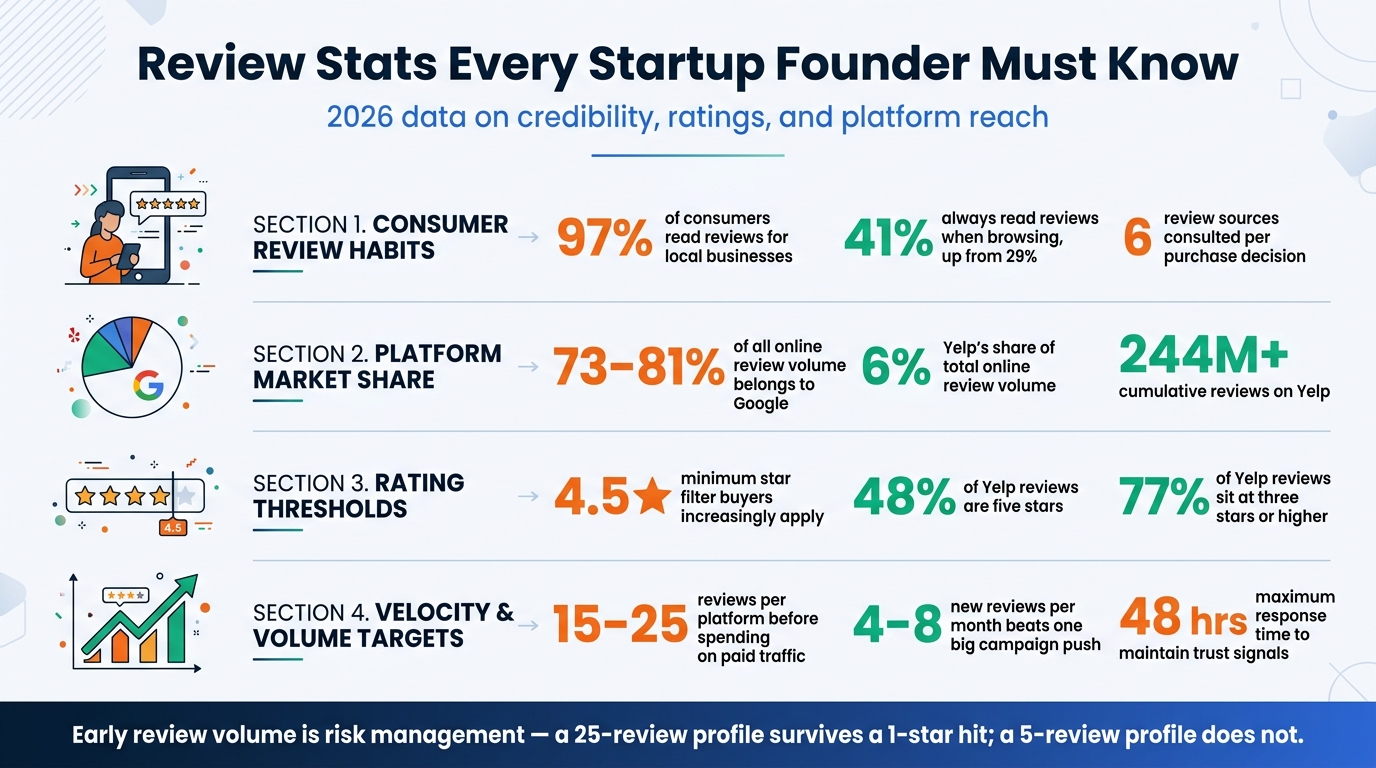
Startup Online Review Statistics and Credibility Benchmarks 2026
2. Startup Review Platforms Strategy: Choosing by Model and Stage
Most guides hand you a list of 20 sites. Use four selection criteria instead:
- Search proximity: is your buyer already searching there?
- Vendor-side requests: can you invite reviews without penalty?
- Indexation: do those reviews show up in search results?
- Link value: is the profile link do-follow?
| Startup Model | Primary Platform | Secondary | Why It Works | What to Watch |
|---|---|---|---|---|
| B2B SaaS | G2 | Capterra, Trustpilot | Buyers arrive with purchase intent; category pages rank for "best [category] software" | Paid tiers gate visibility; badges can be revoked |
| Local or service-based | Google Business Profile | Yelp, Facebook | Google holds most review volume and feeds map results[2] | Profiles get suspended for solicitation violations |
| Marketplace or consumer app | App Store / Google Play | Trustpilot | Ratings sit inside the download decision, not next to it | Version resets and review bombing after releases |
| Healthcare or regulated | Healthgrades | BBB, Google | Older platforms are regaining use in trust-sensitive categories[1] | Compliance limits on asks and published content |
| Pre-revenue or pre-launch | Startup ranking platforms (e.g. StartupRanking) | Product Hunt, industry communities | Verifiable third-party profile and indexed links before customers exist | Incomplete profiles signal abandonment |
Pre-launch and pre-revenue: build proof before you have customers
When nobody can review you yet, credibility comes from verifiable presence: a complete startup profile, consistent name/address/phone and links, press mentions, and objective ranking signals.
That last one gets underused. A Premium Profile on StartupRanking produces an SR Score calculated from the daily movement of your inbound and outbound links plus social engagement — a third-party number you didn't set yourself, on an ad-free page with do-follow links.
Timing matters during launch week. If your Product Hunt day, funding news, and press outreach land in the same 72 hours, a listing stuck in a queue is wasted. Faster Approval gets the profile live within 24 hours, while people are actively searching your name.
Sequencing: pick three platforms, not ten
- Claim and complete the highest-share platform for your model. For most startups that's Google.[4]
- Add one industry platform your buyers name on sales calls — the one they mention unprompted, not the one you assume.
- Add one neutral, indexed third-party profile, so your branded search results include something you don't own.
3. Building Review Velocity Without Breaking the Rules
Consumers discount old reviews, so a slow trickle outperforms a single campaign.[1] Thirty reviews all posted in one month look like a one-time hustle. Four a month for eight months looks like a working business.
Ask at the moment value is delivered
Build the ask into moments where the customer just got something: onboarding completion, a support ticket resolved well, a renewal, or a requested feature shipping.
Keep the message plain:
Hi [Name] — glad [specific outcome] is working out. If you have two minutes, a short review helps other teams figure out whether we're a fit. Direct link: [review form URL]. No script — honest feedback is more useful to us.
Link straight to the form. Every extra click loses people. Cadence target for a small team: 4–8 new reviews per month per priority platform, tracked in the same dashboard as pipeline metrics.
What not to do: gating, incentives, and fake reviews
- Review gating — surveying first and only inviting the happy customers
- Paying for reviews or discounting in exchange for five stars
- Employees, friends, or investors posting as customers
- Copy-paste responses to every review
Consumers actively spot and punish fake reviews, and silence or generic replies read as red flags on their own.[1] The platform consequences are concrete: Yelp filters reviews it considers solicited, Google suspends profiles, and B2B software sites strip vendor badges.
Responding: recency, tone, and accountability
Three standards, held consistently: reply within 48 hours, name the specific issue in the reviewer's words, and state what changed — or admit honestly that it hasn't yet. Responsiveness is itself a trust signal.[1]
"Reviews are stable, sticky, and more important than ever."
4. Turning Reviews Into SEO and AI-Search Visibility
Reviews are indexable content and citation fuel. BrightLocal's point is that businesses now need to be worthy of citation in both Google and LLMs like ChatGPT.[1] Answer engines summarize what they can verify across sources, so thin or inconsistent information produces wrong summaries about you.
Make review signals machine-readable and consistent
- Identical company name, category, and URL on every profile. "Acme Labs" and "Acme Labs Inc." look like two companies to a machine.
- Review schema markup on testimonial and case study pages.
- Publish customer outcomes as on-site case studies so review language also lives on your own domain.
- Keep profile descriptions factual. Vague claims get summarized into vague answers.
Pair reviews with link and content signals
Review profiles rarely rank on their own. They need supporting authority — and that's where early teams stall, because manual directory submissions eat weeks and consistent SEO content usually needs a hire seed-stage startups can't justify.
Two options worth knowing: SR Booster builds a base of 30–120+ directory backlinks so your branded results stop being a blank page, and AutoRankr keeps articles publishing on schedule without a content hire. Once you have a proof-heavy landing page, SR Advertising can push startup-ecosystem traffic to it.
The urgency is competitive. Funding and attention are concentrating in a few categories, making trust harder to earn in crowded markets.[5] Scrutiny also rises as you mature — startups approaching funding or IPO milestones get diligence-checked on public reputation.[6]
5. A 90-Day Startup Review Platforms Strategy and Metrics to Track
| Window | Actions |
|---|---|
| Days 1–30 | Claim and fully complete three platforms. Publish a startup profile with a verifiable score. Lock your name/description standard in a shared doc. Install the review request trigger inside onboarding. |
| Days 31–60 | Reach 15+ reviews on the primary platform. Launch the 48-hour response SLA. Add review schema and one proof page on-site. Start directory link building. |
| Days 61–90 | Add the second industry platform. Publish two customer case studies. Audit rating distribution and review recency. Search your brand name in AI tools and check what they say. |
Monthly metrics
- Review count and average rating per platform
- Review recency — share posted in the last 90 days
- Response rate and median response time
- Branded search impressions
- Referral traffic from review and directory profiles
- SR Score movement
Review these next to pipeline numbers, monthly, in the same meeting. Reputation work that lives outside the metrics review quietly stops happening.
Conclusion: Key Points
- Reviews decide whether you enter consideration at all: 97% of consumers read them and 41% always do.[1]
- Buyers check around six sources, so proof has to be corroborated across platforms, not stacked on one.[1]
- Google carries most review volume, making it the default first platform, with one industry platform second.[2][4]
- Pre-revenue startups build proof through third-party profiles, ranking signals, and links — not customer reviews.
- Velocity and recency beat one-time pushes; gating, incentives, and generic replies create real risk.
- Consistent naming, schema, and link authority make review signals usable by Google and AI answer engines alike.
If you have no reviews yet but need something verifiable pointing at your startup, that's the gap a third-party profile fills. You can register your startup and get an SR Score based on real link and social signals — a starting point for the credibility surface you'll spend the next 90 days building.