

Your startup's reputation reaches customers before your product does. With 81% of shoppers researching a business online before buying and 98% reading reviews before engaging[6][4], the branded search results, reviews, and founder profiles you own (or don't own) act as your first sales pitch.
Here's what this online reputation management for startups playbook covers, upfront:
ORM explains 35% of small business performance variance and 9% of Google Star rating variance[3] — it's not a soft metric.
The Bootstrap ORM Flywheel: Monitor → Own → Generate → Amplify → Respond, runnable on $0 with free tools.
Investor-grade visibility: how VCs vet founders through Crunchbase, LinkedIn, and startup rankings before term sheets.
AI search optimization (GEO): how to shape what ChatGPT, Perplexity, and Google AI Overviews say about your brand.
A founder-friendly crisis decision tree for when you don't have a PR team.
The ORM industry is growing from $8.9B in 2025 to a projected $28.4B by 2034[5], and VCs are pouring capital into reputation intelligence (Signal AI just raised $165M)[8]. Startups that systematize visibility and ranking early compound an advantage incumbents can't buy back. Here's how to build it.
1. What Online Reputation Really Means for a Startup
Startup ORM isn't just review scores. It's the sum of every signal a customer, investor, or reporter finds when they type your name into Google — branded search results, reviews (Google, G2, Trustpilot, Product Hunt), social chatter, press mentions, founder profiles (LinkedIn, AngelList, Crunchbase), employee reviews (Glassdoor), and AI-generated brand summaries[1][4].
The core problem for early-stage teams is what I'll call the trust deficit. Incumbents like Salesforce or Notion have a decade of goodwill cushioning any single negative signal. You don't. A single 1-star review, an unresolved Twitter dispute, or a stale Crunchbase profile can define your brand for months. 94% of consumers have avoided a business because of a negative review[4]. When you don't have brand awareness to fall back on, every signal is amplified.
The good news: most competitors aren't paying attention. 53% of small businesses do not actively manage their reputation, and 60% never ask for reviews[3]. That's an open field for any startup willing to run a systematic ORM program from day one.
1.1 The Four Audiences Watching Your Reputation
Your reputation isn't one thing — it's read by four different groups, each with different filters:
Customers: 49% trust online reviews as much as personal recommendations[4]. They're checking G2, Trustpilot, and Reddit before booking a demo.
Investors: VCs vet founders on AngelList, Crunchbase, and LinkedIn before sending term sheets. Missing profiles or stale metrics signal that the team doesn't take positioning seriously.
Talent: Senior engineers cross-check Glassdoor and LinkedIn ratings before leaving Big Tech. Weak employer signals cost you offers.
Partners and press: Journalists and integration partners Google your brand before replying to a cold email. What appears on page one determines whether they respond at all.
Once you understand who's watching, the next question is how to build a system that speaks to all four — without burning your entire seed round on agencies.
2. The Bootstrap ORM Flywheel: A Zero-to-Low-Cost System
Most ORM guides are written for enterprises with six-figure retainers. Founders need something different: a repeatable loop that works on nights and weekends. I call it the Bootstrap ORM Flywheel, and it has five steps:
Monitor — catch mentions before they spread.
Own — claim your branded search real estate.
Generate — systematize reviews and social proof.
Amplify — turn wins into backlinks and press.
Respond — engage with every signal, positive or negative.
The entire flywheel runs on free tools until you're generating revenue. Here's how each step works in practice.
2.1 Monitor: Setting Up Free Listening Infrastructure
You can't manage what you don't see. Spend an afternoon setting up:
Google Alerts for your brand name, founder names, product name, and common misspellings[1].
Google Search Console to track branded search impressions and click-through rates.
F5Bot for free Reddit and Hacker News keyword alerts.
X saved searches for mentions without @-tags.
LinkedIn notifications for company page tags and founder profile mentions.
Then, once a quarter, manually audit the first two pages of Google results for your brand. Automated tools miss context — a founder's eye catches reputation drift that keyword alerts don't.
2.2 Own: Claiming Your Branded Search Real Estate
Every result on page one of "yourbrand" search is either yours or someone else's. Owning branded SERPs is both defensive and offensive ORM[2] — it pushes negatives down and helps positive signals compound.
Priority claims:
High-authority startup directories and ranking platforms: StartupRanking, Product Hunt, Crunchbase, G2, Capterra.
LinkedIn company page and founder profiles (with consistent messaging across all).
An About page and press page on your own domain, optimized for your brand name.
Organization schema and review schema markup to unlock rich snippets and Knowledge Panel eligibility.
Directory listings solve two pain points at once: manual submissions are time-consuming, and slow approval processes hurt momentum. Platforms with fast-track approval get you visibility in hours instead of weeks.
2.3 Generate: Systematizing Reviews and Social Proof
Here's a stat that should change your Monday morning: 70% of customers will leave a review when asked[1]. The bottleneck isn't customer reluctance — it's founder hesitation.
Automate the ask at natural milestones: onboarding completion, first successful use, feature adoption, renewal. A single scheduled email with a direct link to G2 or Trustpilot converts more than any clever campaign.
"Social proof is the difference between being in business and being out of business." — Harrison Fowler, RVF International[7]
Beyond stars and quotes, add video testimonials, case study pages, and a customer logo bar to your homepage. Each element is a fresh reputation signal indexed by search engines and, increasingly, by AI models.
Once reviews and mentions are flowing, the next question is how to make them do double duty as SEO assets.
3. Integrating SEO with Online Reputation Management for Startups
Most competitor guides treat ORM and SEO as separate departments. They're not. Branded SERPs, review-rich snippets, and Knowledge Panels are simultaneously reputation and organic-traffic assets[2]. Every review is a ranking factor. Every directory backlink is a trust signal.
The proof: RevenueJump's analysis of 54,376 listings found top-ranked local businesses had an average of 38 reviews versus 14 for the lowest[1]. Review volume isn't just credibility — it moves you up the SERP.
3.1 Building Backlinks Through Reputation Channels
Directory submissions, startup rankings, and press mentions serve double duty: they earn do-follow backlinks and expand your reputation surface. A prioritized outreach list looks like:
Startup directories with do-follow links (StartupRanking, BetaList, Product Hunt).
Niche industry lists for your specific vertical.
Podcast interviews — a 30-minute conversation earns a permanent branded backlink and a searchable transcript.
Founder guest posts on trade publications your buyers already read.
For founders drowning in manual submissions, curated backlink packages on ranking platforms compress weeks of outreach into a single workflow. That's where tools like StartupRanking's Booster save real time — 30–120+ directory backlinks without the copy-paste marathon.
3.2 Optimizing for AI Search and Generative Engines (GEO)
Here's the gap nobody else is covering: AI Overviews, ChatGPT, Perplexity, and Gemini are now summarizing your brand from third-party sources. When a prospect asks Perplexity "is [your startup] legit?", the answer is built from Crunchbase, review sites, press coverage, and ranking platforms — not your homepage.
Generative Engine Optimization (GEO) tactics for startups:
Publish structured, data-rich content — LLMs favor content with clear facts, dates, and citations.
Secure citations in high-authority startup databases (Crunchbase, StartupRanking, Product Hunt) — these are common training and retrieval sources.
Monitor LLM outputs by prompting ChatGPT, Perplexity, and Gemini with your brand name monthly. Log what they say. Correct inaccuracies by earning new, authoritative third-party mentions.
Use FAQ schema and clear H2/H3 structure — AI summarizers extract answers from well-structured pages.
Owned content matters less than it used to. Third-party mentions now shape AI-generated brand descriptions more than anything you publish yourself.
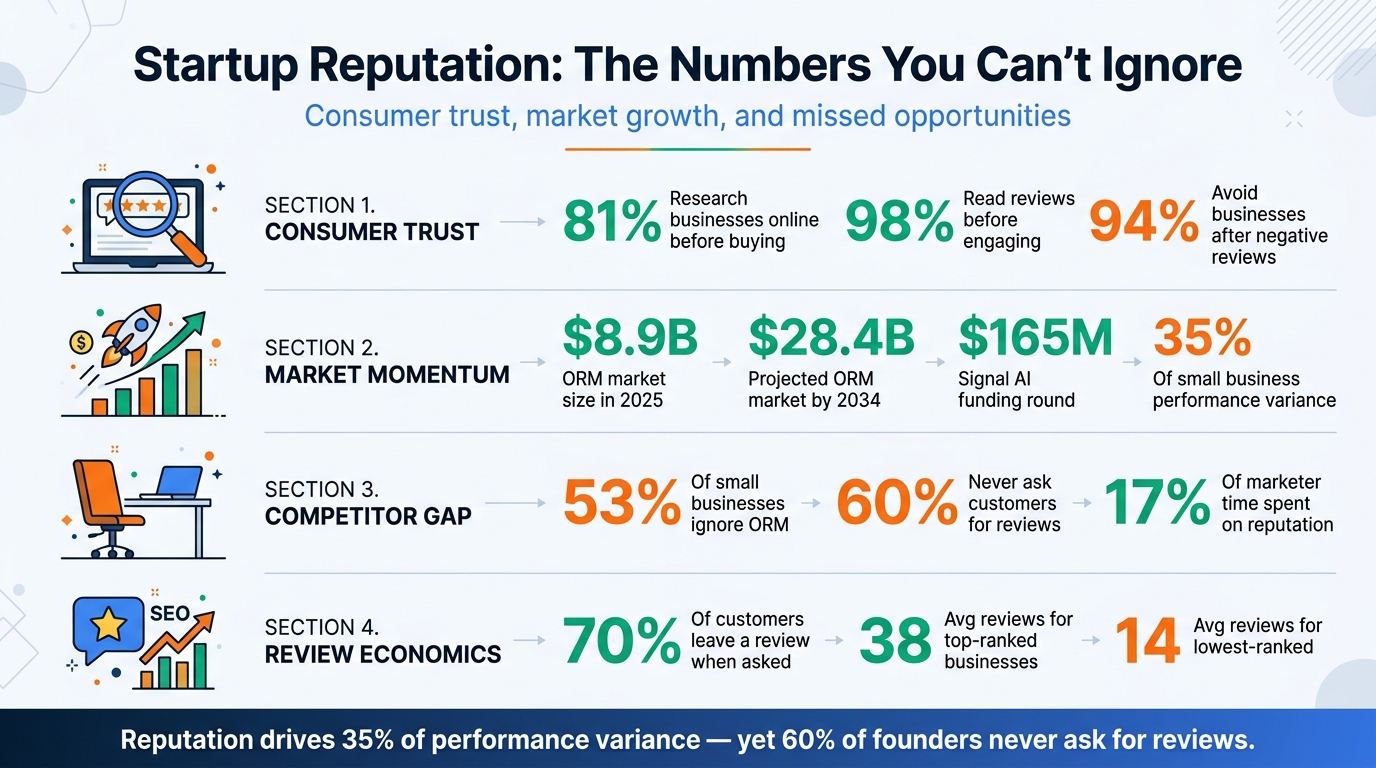
Startup Reputation Impact Statistics for Founders
SEO integration handles customers and search engines. But there's a second audience quietly making decisions about your future based on the same signals.
4. Investor-Grade Reputation: How ORM Affects Fundraising and Hiring
Reputation is due diligence. VCs research founders and product traction through the exact same channels customers use — sometimes literally reading your Trustpilot reviews before a partner meeting. The difference between "coachable" and "concerning" often comes down to what a five-minute Google search reveals.
4.1 What Investors Look For Before a Term Sheet
Investor due diligence checks:
Public rankings and growth signals — a rising SR Score, an ascending Product Hunt rank, or a Crunchbase profile with visible traction all suggest momentum.
Third-party validation — press mentions, awards, and integrations from credible brands.
Consistency across founder LinkedIn, product website, and press coverage. Mismatched titles, outdated metrics, or contradictory positioning are red flags.
Absence of unresolved public disputes. The Delve YC case is a cautionary example — allegations of open-source license violations amplified reputational damage well beyond the original complaint[9].
A clean, current, well-ranked profile on a global startup ranking platform gives investors an at-a-glance snapshot they can trust. It's also one of the fastest ways to solve the "difficulty attracting investors and qualified leads" problem most seed-stage founders face.
4.2 Employer Branding to Compete for Talent
Every senior candidate you want has a competing offer from a company with better Glassdoor scores. Employer branding is ORM applied to hiring.
What works:
Ask employees to leave Glassdoor and LinkedIn reviews after positive milestones — first shipped feature, promotion, work anniversary.
Respond to every review, positive or critical, in the founder's voice. Silence looks worse than a mixed review.
Publish culture content — team AMAs, engineering blog posts, transparent hiring pages — that shows up in branded search.
Even the best-managed reputation can crack under pressure. What separates startups that survive a bad news cycle from those that don't is having a plan before it happens.
5. Crisis Management for Resource-Constrained Founders
Startups face reputation crises without PR teams, legal counsel, or dedicated community managers. A single viral tweet can be existential. Two recent cases show how fast things escalate: a 16-year-old founder's public dispute with a customer went viral across news outlets[11], and the Delve open-source controversy compounded into ongoing reputational damage after each new revelation[9].
The playbook below assumes you're the founder, the community manager, and the head of PR all at once.
5.1 A Founder's Crisis Decision Tree
Identify the type. Is the issue factual (a real bug or policy failure), perceptual (misunderstanding), or malicious (bad-faith attack)[2]? Each requires a different response.
Acknowledge publicly within one hour on the platform where the issue originated. 42% of consumers complaining on social media expect a response within an hour[1]. Silence multiplies the damage.
Move resolution offline. DM, email, or call. 39% of negative reviewers want an apology and will often update or remove reviews after a sincere resolution[1].
Publish a post-mortem or clarifying content to reclaim branded search results. A well-written recap outranks the original complaint over time.
5.2 Review Response Templates and Communication Scripts
Draft these before you need them:
Negative review acknowledgment: "Thanks for taking the time to share this. I'm the founder — I'd like to understand what happened. Can we jump on a quick call?"
Factual correction: "Appreciate the feedback. To clarify [specific fact], and here's what actually happened…"
Refund or resolution offer: "That's not the experience we want. I've refunded your account and sent details to your email."
No-comment situations (legal or personnel): "We can't comment on individual cases, but we take this seriously and are reviewing internally."
"I want them to feel like they were seen and heard, and it wasn't just some bot doing auto reply, it's the CEO/founder that's replying to them personally and directly." — Leena Chitnis, Timberdog[7]
Crisis preparation is reactive. But the biggest ORM wins come from work done long before your first complaint — before your first customer, in fact.
6. Pre-Launch Reputation Building: The Day-One Playbook
Reputation work should start before revenue, not after the first crisis. Building proactively costs a fraction of repairing reactively[4]. Every day you delay is a day a competitor could claim your branded search real estate.
6.1 A 60-Day Pre-Launch Checklist
Days 1–20: Claim and set up
Claim founder profiles on LinkedIn, Crunchbase, AngelList.
Register the company on StartupRanking, Product Hunt (upcoming), and G2 (if applicable).
Set up Google Alerts and F5Bot for brand and founder names.
Days 21–40: Content foundation
Publish 3–5 cornerstone blog posts: founder story, problem thesis, market vision, product overview, early customer stories.
Repurpose each post across LinkedIn, X, and a newsletter.
"We will post the blog content out there, which very much helps us with our SEO, but once we've posted that blog content out there, we will take a snippet of that information and post it on our social media channels, as well as include it in our newsletters that we're sending out." — Jennifer Yancie, Jeyancie Beauty[7]
Days 41–60: Community and momentum
Build a beta community (Discord, Slack, or Circle) to seed early advocates.
Line up 5–10 launch-day supporters who will leave first reviews, upvote on Product Hunt, and share on social.
Draft crisis response templates (see Section 5.2).
6.2 Leveraging Product Hunt and Startup Rankings for Launch Momentum
A well-coordinated launch stacks reputation signals in a single week:
Product Hunt launch with a pre-warmed subscriber list, a hunter relationship, and a founder comment ready at 12:01 AM PT.
StartupRanking registration to gain a global visibility score, do-follow backlinks, and investor-facing exposure through the SR Score algorithm — which tracks daily evolution of inbound/outbound links and social engagement.
Press outreach to trade publications with a launch angle tied to your thesis, not your feature list.
Every one of these signals compounds. A single Product Hunt Top 5 finish continues to drive branded search and backlinks for years.
Once you have the plays, the last question is which tools to run them on — and how much to spend.
7. Tools and Budget: What to Use When You Have $0 vs. $500/Month
Marketers already spend around 17% of their time on reputation management[10]. For a solo founder, that's essentially a full day per week — which is why automation matters more than tool choice.
7.1 Free vs. Paid ORM Stack Comparison
Category | Free Tier ($0) | Growth Tier (~$100–$500/mo) |
|---|---|---|
Monitoring | Google Alerts, F5Bot, Search Console | Mention, Brand24 |
Reviews | Manual email requests, Google Business Profile | Judge.me, Trustpilot Basic |
Social listening | X saved searches, LinkedIn notifications | Sprout Social entry, Hootsuite |
Directories & backlinks | Manual submissions to top 10 directories | StartupRanking Booster (30–120+ backlinks), Premium Profile |
Content | DIY blog + newsletter | Outsourced SEO writers or automated tools |
Analytics | GA4, Search Console | Ahrefs Starter, SEMrush |
Recommended sequencing: start free for the first 90 days. Add paid tools only when a manual task starts eating more than three hours a week. The right upgrade order is usually: (1) directory backlinks (biggest SEO and reputation multiplier), (2) review automation, (3) social listening, (4) advanced analytics.
Conclusion: Reputation Is the Compounding Asset You Can't Afford to Ignore
Reputation is not a marketing line item — it drives 35% of small business performance variance[3], and it compounds hardest for startups that start early. Every review, backlink, and directory listing you earn in month one is still working for you in year five.
The five takeaways:
Monitor with free tools from day one — Google Alerts, F5Bot, Search Console.
Own your branded search real estate through directories, schema, and consistent founder profiles.
Generate reviews systematically by asking at natural milestones — 70% will say yes.
Prepare a crisis decision tree before you need it, with response templates ready.
Optimize for AI search now — third-party mentions shape what LLMs say about you.
The fastest way to check three of those boxes at once is to claim your global ranking profile. Register your startup on StartupRanking to earn branded search visibility, do-follow backlinks, and investor-facing exposure through the SR Score algorithm — no six-figure agency retainer required.