

A workable startup press coverage strategy treats press as an earned-media system, not a blast. Build one provable asset, pitch a short list of fitting journalists, make it easy to say yes, then track the coverage and links you earn.
Four realities shape the work:
- Fit decides coverage. In Cision’s survey of more than 3,000 journalists across 19 markets, 86% said they would immediately reject a pitch that did not align with their beat or audience.[1]
- Proof helps. Reboot Online found that 42.3% of the 2023–24 campaigns it analysed were data-driven[2], and BuzzStream reports that 47% of journalists want data and research.[3]
- Coverage does not always mean a backlink. In Reboot Online’s analysis of 2024 links, 48% were follow links, around 33% were syndicated copies, and 19% were nofollow.[2] Paid advertising and sponsorship links should use
rel="nofollow"orrel="sponsored".[4] - Expect months. BuzzStream reports that 85.2% of respondents see measurable results within six months.[3]
What press coverage that helps SEO actually is
Coverage does not automatically become a backlink. You may get an editorial follow link, a syndicated copy, a nofollow link, an unlinked brand mention, or no pickup at all. Track each outcome separately.
In Reboot Online’s analysis of 2024 links, almost half were follow links, about a third were syndicated, and about a fifth were nofollow.[2] These are distinct outcomes, each with a different next step:
| Outcome | What it is | Typical SEO / referral value | What to do next |
|---|---|---|---|
| Editorial follow | An original article links to your site with a normal link | Can pass ranking credit and bring referral traffic | Thank the writer, monitor the link, and share the piece |
| Syndicated | A story is republished across a network or partner sites | Referral value varies; canonical handling varies | Focus on the original placement, not every copy |
| Nofollow | The link has a nofollow attribute | Can bring referral and brand value; ranking impact is not assured | Leave it as a brand signal |
| Unlinked mention | Your brand is named without a link | Brand value, but no direct referral link | Send one polite request with the URL |
Earned and paid coverage are different. Google lists buying or selling links for ranking purposes, and advertorials or press releases with ranking-credit or optimized-anchor links, as link spam.[4] Paid advertising or sponsorship links are not a policy violation when qualified with rel="nofollow" or rel="sponsored".[4] Never promise, require, or pay for a followed link.
Authority can be high, but it is not guaranteed. Reboot Online’s analysis of 2024 digital PR coverage found an average DR of 61 and UR of around 11, with 20.62% of analysed links in the DR 70–79 range.[2] Relevance and consistency matter more than chasing one high DR.[5]
Startup Press Outreach Statistics for Founders
Find a provable story without a funding round
If you do not have a champagne moment, do not force a release. Startup releases commonly cover funding, new business, senior hires, products, partnerships, licenses, acquisitions, or industry research.[6] Otherwise, build a repeatable story asset.
Try one of three routes: small proprietary data from a survey, usage trends, or a pricing snapshot; founder expertise tied to timely news through timeliness, impact, prominence, proximity, or human interest; or customer proof and local impact, such as hires, customers, or community work.[5]
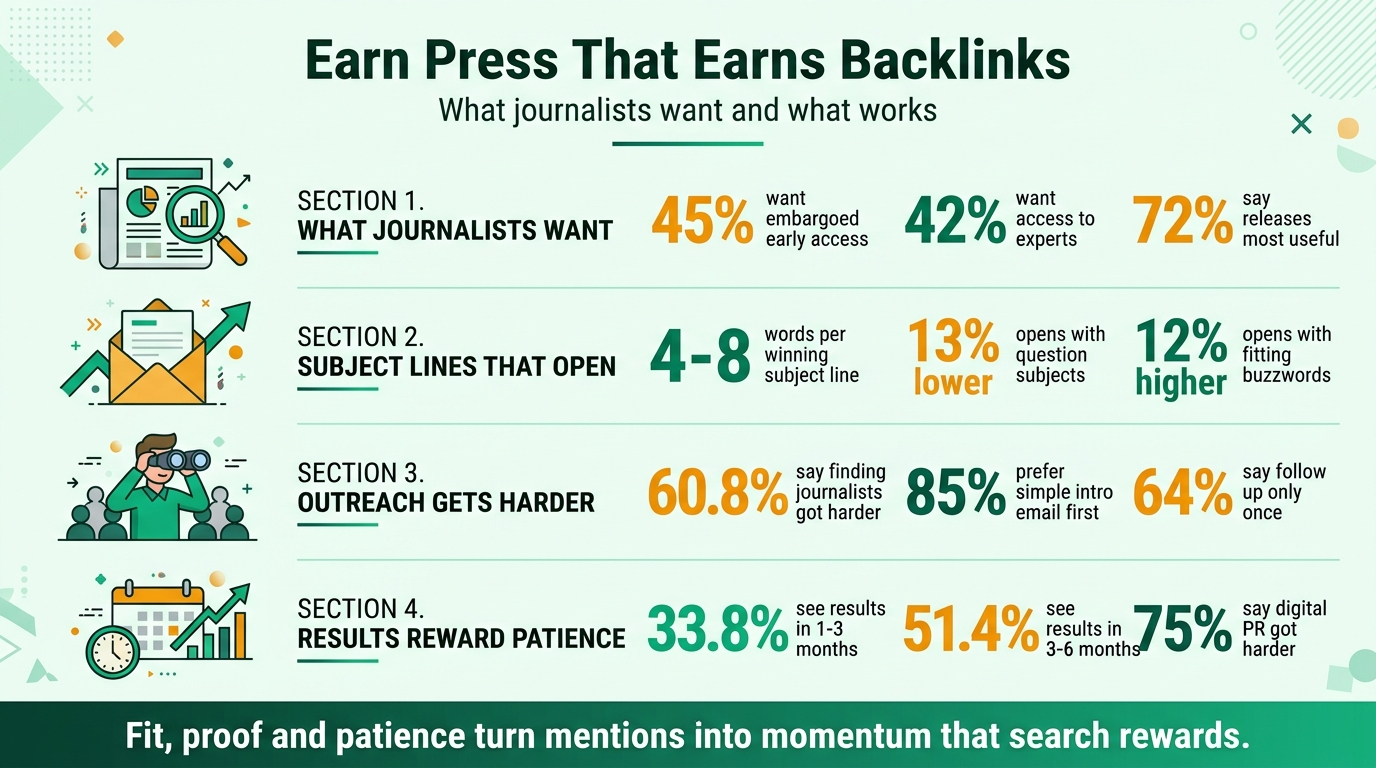
Journalists want data and research, embargoed or early access, and access to experts. BuzzStream reports that 47% want data or research, 45% want embargoed or early-access information, and 42% want access to experts.[3]
"Journalists are always on the lookout for unique data points that can either inspire or support a new story. If you can get them to link to your data, you instantly build credibility and authority on the topic. Then organic links will follow."
— Laura Kutch, Digital PR Specialist, Siege Media [5]
Keep the asset simple: one page, one chart, a short method note, one founder quote, and a hub page on your site with the full data. The hub gives journalists a clear place to link. When you write a release, keep it to 300–500 words, put who, what, when, where, why, and how in the first paragraph, use an inverted pyramid and third person, and add an About boilerplate.[6]
Build a short, relevant outlet list
Prioritize 15 to 30 well-matched contacts over a mass list. Finding relevant journalists is a challenge: 60.8% of digital PR practitioners said it was harder in 2026 than in 2025.[3]
Run a three-step fit check for each contact:
- Read their last 10 articles for beat and audience fit.
- Note whether they link to sources or only mention brands.
- Write one sentence on why this angle fits their readers.
Cision’s survey found that 86% of journalists would immediately reject a pitch outside their beat or audience.[1]
"This year's findings reinforce just how important it is for PR teams to focus on precision, empathy, and adaptability,"
— Jim Daxner, Chief Product Officer and Head of Strategy, Cision [1]
Mix outlet types. Start with beat-relevant trade and niche sites, add national outlets only for true impact or prominence, and add local or regional outlets when hiring, customers, or community impact is real. In the U.S., the local news ecosystem includes 8,000 tracked outlets and 695 stand-alone digital outlets, up from 662; 212 counties have no local source and 1,525 have only one.[8]
Plan for social discovery too. Among 18–24-year-olds, 39% cite social media as their main news source, compared with 24% for websites and apps; in 2015, the figures were 21% and 36%.[7] Prepare a social-friendly chart and a short video cut. Reuters Institute experts also forecast increased demand for verification as news discovery shifts, so keep method notes, raw numbers, and sources ready.[9]
Start the relationship before you need it. Cision reports that 85% of journalists say the best way to build a relationship is to introduce yourself by email, even without a story to pitch.[1] A complete public profile on StartupRanking can give journalists a quick fact-check and a page to link to while outreach runs.
Pitch and follow up so a busy reporter can say yes
Use a short pitch for an idea, commentary, or data exclusive. Use a formal release for a significant announcement, sent as an attachment with “press release” or “PR” in a clear subject line.[6] Cision reports that 72% of journalists cite press releases as the most useful resource PR teams can offer.[1]
| What to decide | Short personalized pitch | Formal press release |
|---|---|---|
| When to use | Data point, expert comment, or exclusive angle | Funding, launch, hire, partnership, or research |
| Length / structure | 120–180 words: hook, audience value, one ask | 300–500 words, 5W1H lead, quote, boilerplate |
| Attachments | One-pager, chart, link to hub page | Release document, photo, method, available contact |
Keep subject lines to 4–8 words and under 11. In Reboot Online’s study of more than 1,000 subject lines, question formats had about 13% lower open rates than non-questions, while subject lines with buzzwords had about 12% higher open rates.[2] Use a buzzword only when it genuinely fits the story.
Personalize with the journalist’s name and recent work, lead with the hook, and make one clear ask. Offer an embargo when appropriate: BuzzStream reports that 45% of journalists want embargoed or early-access information.[3]
Reduce effort for the reporter. Attach the one-pager, chart, photo, and method, and include a contact who is actually available.[6] Human-check every claim: Cision reports that 72% of journalists worry about factual errors in AI-generated PR content.[1]
Follow up once with new value, such as a fresh data cut, local angle, or customer example. BuzzStream reports that 55.4% of PR pros send only one follow-up, and 64% of journalists say to follow up only once.[3] If they pass, do not argue.
Turn a startup press coverage strategy into backlinks and business results
Check coverage at 48 hours, two weeks, and 90 days. Confirm whether a link exists, what attribute it carries, and whether its anchor and context fit your hub page. Thank the writer; for an unlinked brand mention, send one polite request with the exact URL.[5] For syndicated copies, focus on the original placement, and never pay to turn a mention into a follow link.[4]
Take a baseline before you pitch, then measure:
- New referring domains and outlet relevance.
- Referral sessions to the hub page and branded search.
- Target-page visibility, plus demo, contact, or investor leads.
Re-check at one to three months and again at three to six months. BuzzStream reports that 85.2% of respondents see measurable results within six months: 33.8% in one to three months and 51.4% in three to six months.[3] BuzzStream also reports that practitioners commonly track quality links and total mentions; add traffic, rankings, and leads to your own checklist.[3]
Then iterate. BuzzStream reports that getting coverage is the top challenge for digital PR practitioners (26.4%), followed by measuring impact (14.9%); 75% say digital PR is harder in 2026.[3] Keep what earned relevant links, and adjust your targeting, pitch, or proof where it did not.
Conclusion: earn the link by earning the story
Choose a focused list, bring evidence journalists can verify, and make your pitch easy to assess. Treat each kind of coverage separately, follow link rules, and give results time to develop.
If you want to strengthen your discoverability baseline while you build this system, you can register your startup on StartupRanking. Premium Profile, SR Booster, and AutoRankr are optional visibility tools, not substitutes for earned editorial coverage.