
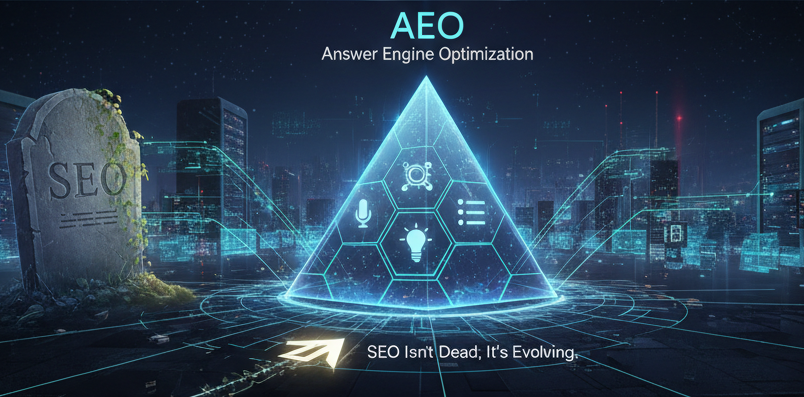
Did you know that 68% of online experiences begin with a search engine, yet 54% of searches now end without a click? This isn't a sign that search is dying. It's proof that it has evolved.
Modern search is no longer just about rankings. It's about answers. Users now expect immediate, accurate responses delivered through AI assistants, voice search, and featured snippets. This shift has led to AEO (Answer Engine Optimization), a new discipline focused on structuring content so it can be understood and selected by intelligent systems.
If you're a business owner, marketer, or startup wondering whether SEO still matters in the AI era, this guide explains what's really happening, why SEO remains essential, and how SEO and AEO work together to maximize visibility.
The myth of "SEO is dead"
This myth comes from real changes in search behavior: AI-generated answers appearing directly in search results, conversational and voice searches becoming more common, and fewer clicks for informational queries, thanks to featured snippets.
These trends can create the impression that traditional SEO is losing relevance, but the reality is quite the opposite. Every AI-generated response, featured snippet, and voice result is powered by content that's discoverable, authoritative, and technically well-structured.
The truth? SEO isn't disappearing. It's the invisible infrastructure that enables modern search experiences.
What SEO really means today
SEO has evolved far beyond keyword stuffing and link farming into a people-first, intent-driven discipline. Modern SEO isn't just about rankings. It's about creating a holistic experience that serves both users and search engines.
Today's effective SEO combines high-quality, valuable content with technical performance optimization, engaging user experience (UX), and credible authority signals.
Without SEO, even the most brilliant content remains invisible. The equation is simple: no SEO = no visibility = no answers.
Introducing AEO: Answer Engine Optimization
AEO, or Answer Engine Optimization, is the practice of structuring content so that it can be directly featured as an answer by AI tools and search engines. While traditional SEO focuses on driving traffic, AEO is about becoming the authoritative source that gets cited as the answer.
AEO in action looks like AI tools like ChatGPT, Gemini, or Microsoft Copilot citing your content, your content appearing in Google's featured snippets and "People Also Ask" sections, and your information powering voice search responses from Alexa or Siri.
For startups looking to build visibility early, understanding this distinction matters. You can track which companies are gaining traction across both traditional search and AI-driven discovery by monitoring platforms like Startup Ranking, where emerging teams often show up before they dominate mainstream channels.
SEO vs AEO: Understanding the difference
Many people think AEO is the "replacement" for SEO. That's not true. They solve different problems, and the strongest digital strategies use both in tandem.
SEO optimizes for search engine crawlers, focuses on keywords and search rankings, aims to drive qualified traffic and clicks, and builds long-term site authority. AEO, on the other hand, optimizes for answer engines and AI models, focuses on questions and conversational intent, aims to gain visibility within answers even without clicks, and highlights specific answers instantly.
Think of it this way: SEO is like building a library and meticulously cataloging every book. AEO is the expert librarian who can instantly pull the most relevant paragraph from the best book to answer a user's question.
Why SEO and AEO work best together
SEO provides structure, relevance, and authority. AEO amplifies that foundation by increasing visibility in featured snippets and AI answers, expanding brand presence at the top of search experiences, and reinforcing topical authority beyond traditional clicks.
Real-world success stories:
HubSpot's comprehensive marketing guides rank highly in search results (SEO success) while simultaneously being quoted in AI responses about digital marketing strategies (AEO success). This dual presence dramatically increases their brand visibility and authority.
Similarly, ClickUp consistently appears in search results for project management topics and is frequently referenced by AI assistants when users ask about work organization, strengthening its visibility across both traditional search and AI-driven answers.
Research from Ahrefs confirms this synergy: 76 % of AI Overview citations come from pages ranking in the top 10 organic search results, showing that strong traditional SEO performance (ranking highly in Google) significantly increases the likelihood of being cited in AI-powered summary results. (Ahrefs, July 2025)
The unified strategy: How to optimize for both SEO and AEO
To dominate today's search landscape, your content needs to serve both search engine crawlers and answer engine algorithms. Here's a practical framework to optimize for both:
1. Create Answer-Focused Content
Structure your content around specific questions your audience asks. Use tools like AnswerThePublic or analyze "People Also Ask" sections to identify these golden opportunities.
2. Master Structured Headings
Use H2 and H3 tags to create clear hierarchy. Combine headings with bullet points, numbered lists, and short paragraphs to make content scannable for both humans and AI.
3. Write for Intent, Not Just Keywords
Optimize for the reader's underlying intent. What problem are they trying to solve? What outcome do they want? Address these needs directly in a natural, conversational way.
4. Implement Schema Markup
Add structured data, including FAQ or Q&A schemas, to help search engines and AI tools understand your content and increase your chances of appearing in rich snippets.
5. Build Strategic Internal Links
Guide users to related content while distributing authority. Internal links help search engines crawl and index your site and assist AI in understanding context for answers.
6. Earn Quality Backlinks
High-quality backlinks remain one of the strongest indicators of authority. Acquire links from reputable, relevant sources to signal credibility to both search engines and AI systems.
Services like SR Booster from Startup Ranking focus on securing backlinks from high-quality directories, helping startups build early authority, reinforce SEO signals, and increase their chances of being recognized and cited by AI-driven search tools.
7. Maintain Content Freshness
Fresh content signals to search engines and AI that your information remains trustworthy and up to date, helping preserve visibility, authority, and search performance.
Common mistakes to avoid
Dropping SEO for AEO: Don't make this fatal error. AEO without SEO is like building a roof with no foundation.
Writing for Robots: Your content must still be engaging and valuable for humans. Poor engagement signals tell search engines your content isn't helpful.
Ignoring the Fundamentals: Don't chase shiny new trends while neglecting core technical SEO and authority building.
Measuring success in the new search landscape
Track both traditional SEO metrics and AEO performance:
SEO Metrics:
Organic traffic and rankings, click-through rates, and backlink growth.
AEO Metrics:
Featured snippet appearances, voice search optimization results, and brand mentions in AI responses.
Tools like SEMrush and Ahrefs now track featured snippet performance, while newer platforms monitor AI citation frequency, giving you complete visibility into your search success.
The future belongs to those who adapt
SEO hasn't died. It has matured into something more powerful and sophisticated. AEO's rise actually proves SEO works so effectively that AI now relies on it for trustworthy answers.
Remember: SEO builds the source. AEO delivers the answer.
Brands that understand this synergy will dominate visibility, authority, and trust across traditional and AI-driven search. Companies like HubSpot in marketing and ClickUp in work management demonstrate that the future belongs to those who master both disciplines.
The question isn't whether to choose SEO or AEO. It's how quickly you can integrate both into a unified strategy that positions your brand as the definitive source in your industry.