
AI engines now decide who gets discovered — and if your startup isn't inside those answers, you're invisible to a growing share of buyers, investors, and journalists.
Generative engine optimization (GEO) is how you fix that. It's the practice of shaping your content so ChatGPT, Google AI Overviews, Perplexity, Gemini, and Claude retrieve, quote, and cite your startup when someone asks a relevant question. The good news for founders: GEO builds on classic SEO fundamentals, so you don't have to start from scratch[1][3]. The hard news: the sources AI cites are shifting fast, and lean teams need a smarter playbook.
Here's what you'll get from this guide:
- How AI engines actually pick which sources to cite (and why FAQs beat essays)
- The 3-step GEO playbook for startups without a big PR budget
- Which metrics prove your GEO is working
- Google's official "do not do" list for founders chasing AI visibility
- A realistic 90-day starting sequence you can begin this week
Let's dig into why AI citations are quickly becoming the new organic traffic — and how to earn them.
Why Startups Can't Ignore AI Citations
ChatGPT hit 100 million users faster than any consumer app in history, and Google's AI Overviews now reach billions of users every month[4]. Discovery is shifting from a list of ranked blue links to a synthesized answer that mentions only a handful of sources. If your startup isn't one of them, you're not in the conversation.
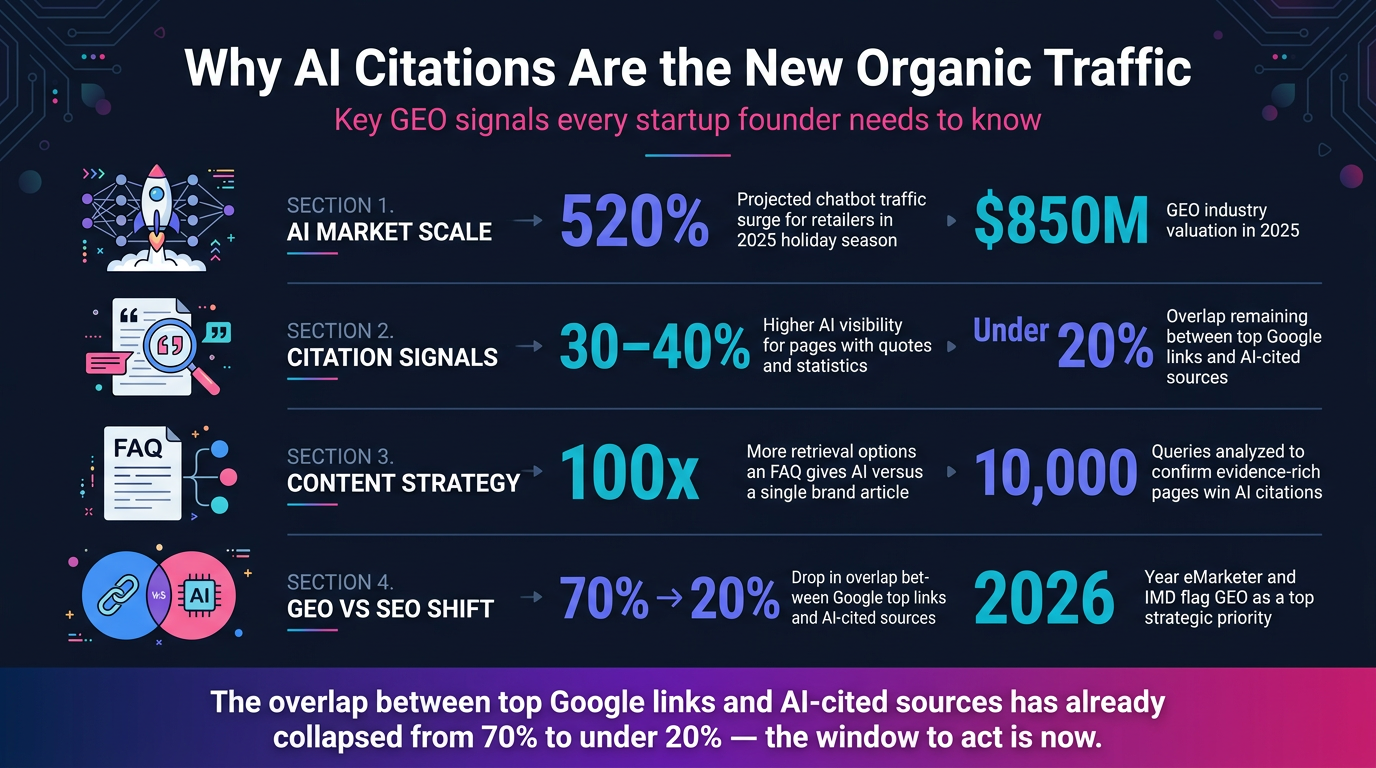
The stakes are already showing up in the data. Adobe research cited by WIRED projects that retailers could see up to a 520% jump in traffic from chatbots and AI search engines during the 2025 holiday season versus 2024, and the GEO industry was valued at nearly $850 million in 2025[2]. That's a lot of money chasing a real behavioral change.
For founders, the pain is familiar: you're already struggling to build online visibility and backlinks with limited time and budget. GEO doesn't make that harder — but ignoring it means the small window of AI-referred traffic goes to your competitors. This guide keeps things practical and lean, treating GEO as an extension of SEO rather than a shiny replacement[1][3].
What Generative Engine Optimization Actually Is (and Isn't)
Generative engine optimization is the practice of shaping content so it gets retrieved, quoted, and cited inside AI-generated answers on ChatGPT, Google AI Overviews, Perplexity, Claude, Gemini, and similar systems[4]. Instead of trying to rank a URL, you're trying to become the sentence, list item, or statistic the AI pulls into its response.
To do that, it helps to understand how these systems find sources. Most large language models use retrieval-augmented generation (RAG): when you ask a question, the model generates multiple related sub-queries (called query fan-out), pulls content from a cluster of pages, and stitches together an answer[1]. The implication for startups is huge: topical depth beats a single keyword page. One well-optimized article isn't enough if the surrounding cluster is thin.
GEO is not, however, a replacement for SEO. Google has been explicit that AI Overviews and AI Mode rely on the same core Search ranking and quality systems as regular search, which means classic SEO fundamentals still power AI visibility[1]. Moz puts it plainly: startups with solid SEO are "much of the way there" for GEO[3].
What has changed is which sources actually get cited. According to WIRED's reporting, Brandlight's CEO estimates the overlap between top Google links and AI-cited sources has fallen from about 70% to under 20%[2]. AI systems are surfacing a different source set — and that's the gap founders can exploit.
GEO vs. SEO: What Changes and What Stays the Same
Here's a side-by-side to make the shift concrete:
| Dimension | SEO | GEO |
|---|---|---|
| Primary goal | Rank a page on the SERP | Get cited inside an AI answer |
| Unit of visibility | Blue link / featured snippet | Sentence, list item, or FAQ block |
| Ranking signals | Backlinks, on-page, E-E-A-T | Same fundamentals plus mentions, freshness, extractability |
| Content format | Long-form pages, pillar content | Extractable FAQs, comparisons, evidence-rich snippets |
| Key metrics | Impressions, clicks, position | AI mentions, citations, AI referral sessions |
The takeaway: your existing SEO investment is the floor, not the ceiling. Next, let's look at how AI engines actually decide who makes the cut.
How AI Engines Choose What to Cite
AI engines don't rank pages the way Google does. They pull content from indexed pages and from unlinked brand mentions across the web, then compose a response. Semrush's research highlights that unlinked mentions, content freshness, server-side rendering, and presence on user-generated content platforms all influence AI visibility[4]. That means a mention of your startup in a Reddit thread or a Product Hunt comment can matter almost as much as a traditional backlink.
Evidence signals matter enormously. A study of 10,000 queries cited by Semrush found that pages containing quotes and statistics had 30–40% higher visibility in AI responses[4]. For founders, the lesson is direct: stop writing "thought-leadership" essays with no numbers. Build citation-rich pages that AI systems can quote confidently.
Structure also beats length. As Brandlight's Imri Marcus told WIRED:
"An FAQ can answer a hundred different questions instead of one article that just says how great your entire brand is. You essentially give a hundred different options for the AI engines to choose."
— Imri Marcus, CEO of Brandlight, quoted in WIRED[2]
An article is one big chunk. An FAQ is fifty tiny, retrievable answers. That's why granular content wins.
Finally, quality still beats quantity. Google's own guidance explicitly warns against "AEO/GEO hacks," scaled content abuse, and producing separate pages for every query variation, noting that high volume doesn't equal higher quality[1]. Publishing 200 mediocre pages a month will not save you.
So which pages should a resource-constrained startup build first? That's what the next section tackles.
The Startup GEO Playbook: Where to Spend Limited Resources First
Most GEO guides read like they're written for enterprise content teams with unlimited budget. That's not you. This section is a prioritization framework for lean startups that can maybe ship 4–8 pieces of content per month, not 200.
Build Extractable, High-Intent Pages
Start with commercial-intent pages first: product pages, use-case pages, comparison pages, and pricing FAQs. Moz's workflow recommends prioritizing queries where AI citations map directly to revenue, not top-of-funnel curiosity[3]. If someone asks ChatGPT "best CRM for freelance designers," you want to be in that answer far more than you want to be in "what is a CRM."
Format each page so AI can lift specific units:
- Direct answer in the first sentence. Don't bury the point. State it, then explain.
- Short paragraphs and bullet lists. Scannable chunks are extractable chunks.
- Tightly scoped FAQ blocks. One clear question, one clean answer, then move on.
- Evidence in every asset. Original data, customer counts, expert quotes, cited statistics. This is what triggers the 30–40% visibility lift[4].
If you've been burning hours on manual directory submissions with little to show, this is where that time is better spent — a single well-structured comparison page can generate AI citations for months. For a shortcut on the directory side, a single submission to StartupRanking's global startup ranking replaces dozens of manual listings with one structured, ranked profile.
Establish Founder-Led Authority and Original Perspective
Google is unusually direct about what it rewards: unique, people-first content with a distinctive point of view. Commodity content gets ignored[1]. For a founder, this is actually good news — you have something the AI-scraped web doesn't: proprietary data and firsthand experience.
Concrete moves that work for early-stage teams:
- Publish original benchmarks from your own product data. Even a single "we analyzed 500 customer signups and found X" post can become a cited source.
- Share a repeatable framework tied to your niche. Give your methodology a name. Named frameworks get quoted.
- Answer the specific questions your ICP asks AI assistants. Ask your customers what they Google (or ChatGPT) before buying, and turn each into a dedicated FAQ answer.
You can also boost your machine-readable footprint by getting listed on structured ranking platforms. A ranked profile on StartupRanking gives you an authoritative backlink and a structured entry — exactly the kind of cross-web mention Semrush identifies as a GEO signal[4].
Earn Mentions Across the Sources AI Actually Reads
Because the overlap between Google's top links and AI-cited sources has dropped below 20%, chasing traditional backlinks alone won't cut it[2]. You need mentions across the surfaces AI engines actually retrieve.
Priority channels for founders:
- Startup directories and ranking platforms. These are structured, frequently crawled, and heavily referenced.
- Industry roundups and "best of" lists. AI systems reuse these constantly for comparison queries.
- Reddit and Quora threads. UGC platforms are increasingly a retrieval source[4].
- Podcast transcripts. Long-form spoken content, once transcribed, becomes highly quotable.
- G2, Product Hunt, and review platforms. AI engines pull context and sentiment from these regularly.
Digital PR for lean teams doesn't require a $10K/month agency. Pitch data stories to journalists (that's why the original benchmark from the section above matters). Contribute expert quotes on platforms like Help a B2B Writer. Get proactive about being included in "best X tools for Y" articles by reaching out to the authors with a genuine, specific pitch.
Generative Engine Optimization Statistics for Startup Founders
With the playbook in place, the next question is how you know it's working.
Measuring GEO: Metrics That Prove It's Working
The old question was "are we ranking?" The new question is "are we being cited, and does it convert?"[3] If you keep measuring only impressions and position, you'll miss the entire GEO channel.
Here's a core metrics stack, drawn from Moz and Semrush guidance[3][4]:
- AI mentions and citations across ChatGPT, Perplexity, Gemini, and Google AI Overviews for your target prompts.
- AI share of voice versus direct competitors on those same prompts.
- AI referral sessions and assisted conversions tracked in GA4 (filter by referrer domains like chatgpt.com, perplexity.ai, gemini.google.com).
- Coverage of owned vs. unowned AI Overviews on your top-10 ranking keywords — where do you rank but not get cited?
A simple monthly workflow, adapted from Moz:
- Pull your top-10 ranking keywords.
- Filter for AI Overview presence.
- Log whether your domain is cited in the AI answer.
- Prioritize the "near-miss" queries — pages that rank well but aren't cited — especially those with commercial intent.
- Rewrite those pages with FAQ blocks, direct answers, and evidence[3].
The market signal is loud too. Both eMarketer and IMD have flagged GEO as a strategic priority for 2026[5][6]. Setting a baseline now — even a rough one — creates a compounding advantage while your competitors are still arguing about whether GEO is real.
You'll also want to keep a shortlist of internal signals: how many investor and lead inquiries mention "I found you through ChatGPT" or "I saw you cited in Perplexity." That anecdotal data is often the earliest sign your GEO work is landing.
Before you sprint into execution, it's worth knowing the traps that catch most teams.
Common Mistakes and What Google Says to Avoid
Every new marketing channel spawns a wave of hacks. GEO is no different — but Google has been unusually blunt about what not to do.
Mistake 1: Chasing "GEO hacks" instead of quality. Google's official AI optimization guide explicitly warns against tactical shortcuts and pages built purely to game AI systems[1]. Any "trick" a vendor is selling you this quarter will likely be worthless — or penalized — by next.
Mistake 2: Mass-producing AI content. Cranking out 500 thin AI-written articles is one of the fastest ways to get flagged for scaled content abuse. Google's guidance is blunt: high quantity of content does not equal higher quality, and producing separate pages for every query variation is not a good practice[1].
Mistake 3: Ignoring the technical basics. Server-side rendering, crawlability, and clean HTML structure are prerequisites, not optional. If AI crawlers can't parse your page, no clever content strategy saves it[1][4]. Check that your key pages render without JavaScript execution.
Mistake 4: Optimizing only for one AI engine. ChatGPT, Perplexity, Gemini, and Claude all consume content slightly differently. WIRED and Semrush both note that startups need format and mention diversity across platforms rather than betting everything on Google AI Overviews[2][4].
Mistake 5: Skipping structured mentions. Founders who focus only on their own blog and ignore third-party listings — directories, review sites, ranking platforms — leave a huge chunk of AI-retrieval real estate on the table.
With the pitfalls flagged, let's turn this into a concrete 90-day plan.
A Realistic 90-Day GEO Starting Point for Founders
Quick recap of what actually matters:
- GEO is the next layer of SEO, not a replacement — foundations still matter[1][3].
- AI engines cite structured, evidence-rich, specifically-scoped content[2][4].
- Prioritize commercial-intent pages, founder-led perspective, and mentions on the sources AI actually reads[2][3][4].
- Measure AI citations, share of voice, and AI referral conversions — not just rankings.
- Avoid hacks, thin content, and single-engine tunnel vision[1].
Here's a 90-day sequence that a two-person team can realistically ship:
Days 1–30: Audit and baseline.
- Audit your top-10 ranking pages for AI Overview presence.
- Set up basic AI-mention tracking (manual prompt checks weekly for your top 20 target queries is fine to start).
- Log AI referrer traffic in GA4.
Days 31–60: Rewrite and structure.
- Rewrite 5–10 high-intent pages with clear direct answers, FAQ blocks, and evidence-rich statistics.
- Fix any technical rendering issues that block AI crawlers.
- Publish one original data asset — even a small internal benchmark counts.
Days 61–90: Expand mentions.
- Secure listings on relevant startup directories, ranking platforms, and review sites.
- Contribute to 3–5 "best of" roundups in your niche.
- Get active in 2–3 Reddit or Quora communities where your ICP asks questions.
None of this requires a big team or a big budget — it requires focus. If you're ready to start building your GEO footprint with a structured, machine-readable profile and authoritative backlinks, register your startup on StartupRanking to add a ranked profile to your discovery surface. It's a small step that plugs directly into the kind of cross-web signals AI engines are actively retrieving from.