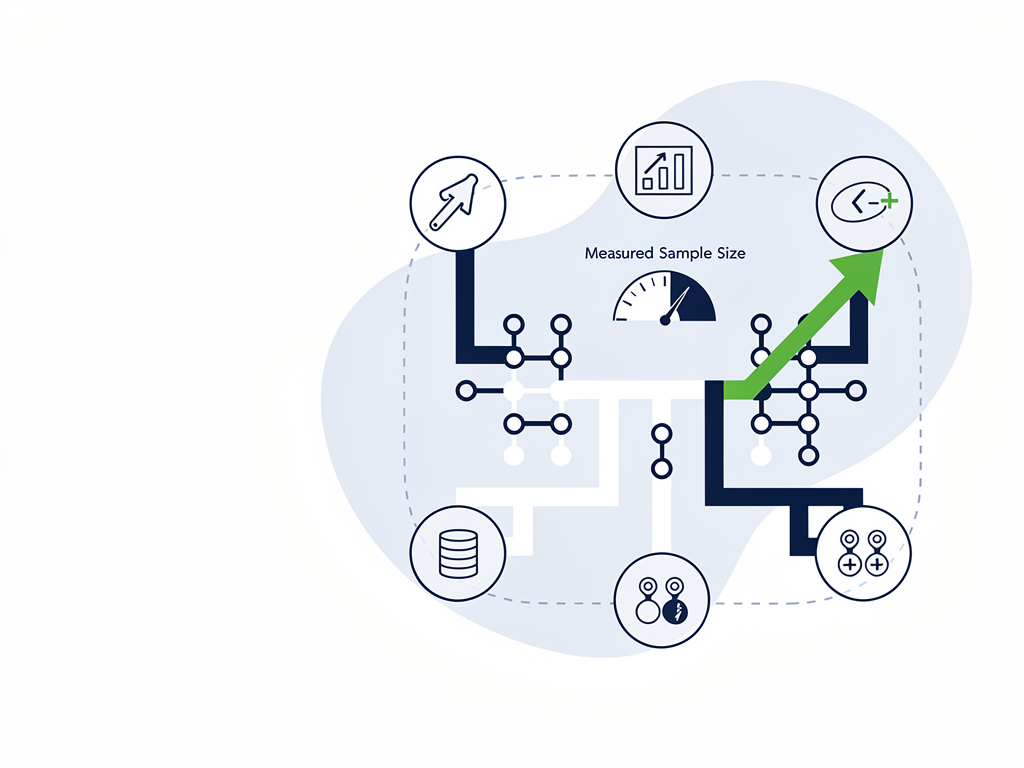
Most startup A/B tests fail for one reason: not enough traffic to produce a trustworthy answer. A/B testing is a quantitative research method that compares two or more versions of a page with a live audience, judged against business-success metrics decided in advance, with traffic split so each visitor sees only one version.[1] That works beautifully at scale. But when it comes to A/B testing startup conversions on 200 visitors a week, the method mostly produces noise that founders mistake for insight.
Here's what this guide gives you:
- A prioritization order — rank test ideas by traffic × drop-off × effort, and test the highest-traffic drop-off first.
- A six-step design checklist you can complete in under an hour, so your tests aren't underpowered.
- A stop rule — if a page can't reach sample size in four to six weeks, go get traffic instead of running the test.
Scope: acquisition pages, signup flow, pricing page, and onboarding. Not enterprise experimentation infrastructure.
1. The three constraints that break startup A/B tests
Enterprise testing advice assumes traffic you don't have. Every recommendation below exists because of three hard limits.
Not enough traffic to detect the lift you are hoping for
How long a test must run depends on three things: your current baseline metric, the minimum effect you want to detect, and your significance threshold — commonly 95%.[1]
Do the math on your own numbers. If a signup page converts at 3% and you want to detect a 10% relative improvement, a site with a few hundred weekly visitors needs months to conclude.
Two options: test bigger changes, or test a page that actually gets traffic — which sometimes means growing your startup's visibility before you test anything at all.
And the classic mistake — stopping the test the moment one variant pulls ahead. Early leads flip constantly. That's variance, not a winner.
Too many variants competing for the same visitors
A/B/n tests compare three or more versions at once, but they need proportionally more traffic to reach significance.[2] Splitting 400 weekly visitors across four variants gives each version 100 people. Nothing concludes.
Practical rule for early-stage teams: one control, one variation, one changed element until your traffic and event tracking mature.[4]
Optimizing a metric that does not move the business
Mature programs look past conversion rate to revenue and retention outcomes — Revenue Per Visitor, Average Order Value, LTV, and subscription frequency.[4] The reason matters: a CTA change can raise clicks while purchase rate and average sale amount both fall.[1]
So before launch, pick one north-star metric plus one or two guardrail metrics. Write them down. A test without guardrails can only tell you good news.
Once you accept those limits, the next question is which experiment deserves your one available slot.
2. What to test first: a prioritization order for startup conversions
Most guides explain mechanics and skip sequencing. Sequencing is the whole game when you can only run one test at a time.
Rank test ideas by traffic × drop-off × effort
For each idea, estimate three numbers:
- Weekly visitors reaching that step — no traffic, no test.
- Percentage lost at that step — big leaks have room to move.
- Engineering days required — copy changes cost hours; onboarding flows cost days.
Landing page copy usually wins on effort. Onboarding usually wins on impact. Test the highest-traffic step with the biggest drop-off — not the step that's easiest to edit.
The four surfaces worth testing in an early-stage funnel
Homepages, ad creative, landing pages, checkout, and forms are the standard test surfaces, mapped to conversions, revenue, and retention.[3] Translated to an early-stage SaaS funnel:
- Acquisition landing page — headline and value proposition, primary CTA, form length, social proof placement.
- Signup flow — number of fields, email-only vs. full profile, credit card vs. no card.[5]
- Pricing page — plan order, annual vs. monthly default, feature framing.
- Onboarding and activation — first-run checklist, empty-state prompts, time-to-first-value.
A/B testing is used across ecommerce, SaaS, media, and email[1] — which is your permission slip to test past the marketing site, where activation actually happens.
Test bigger changes when traffic is small
Small effects need large samples. So early-stage teams should test distinct alternatives — a different value proposition, a different pricing structure, a different onboarding path — rather than micro-tweaks like button shades.
Optimizely's own homepage experiment makes the point: visitors who saw a playful dog interaction, shown 50% of the time, consumed 3x more content than visitors who didn't.[3] One non-obvious change, a large behavioral shift. That's the size of effect small-traffic teams need to hunt.
With the target chosen, the design of the test determines whether the result is usable.
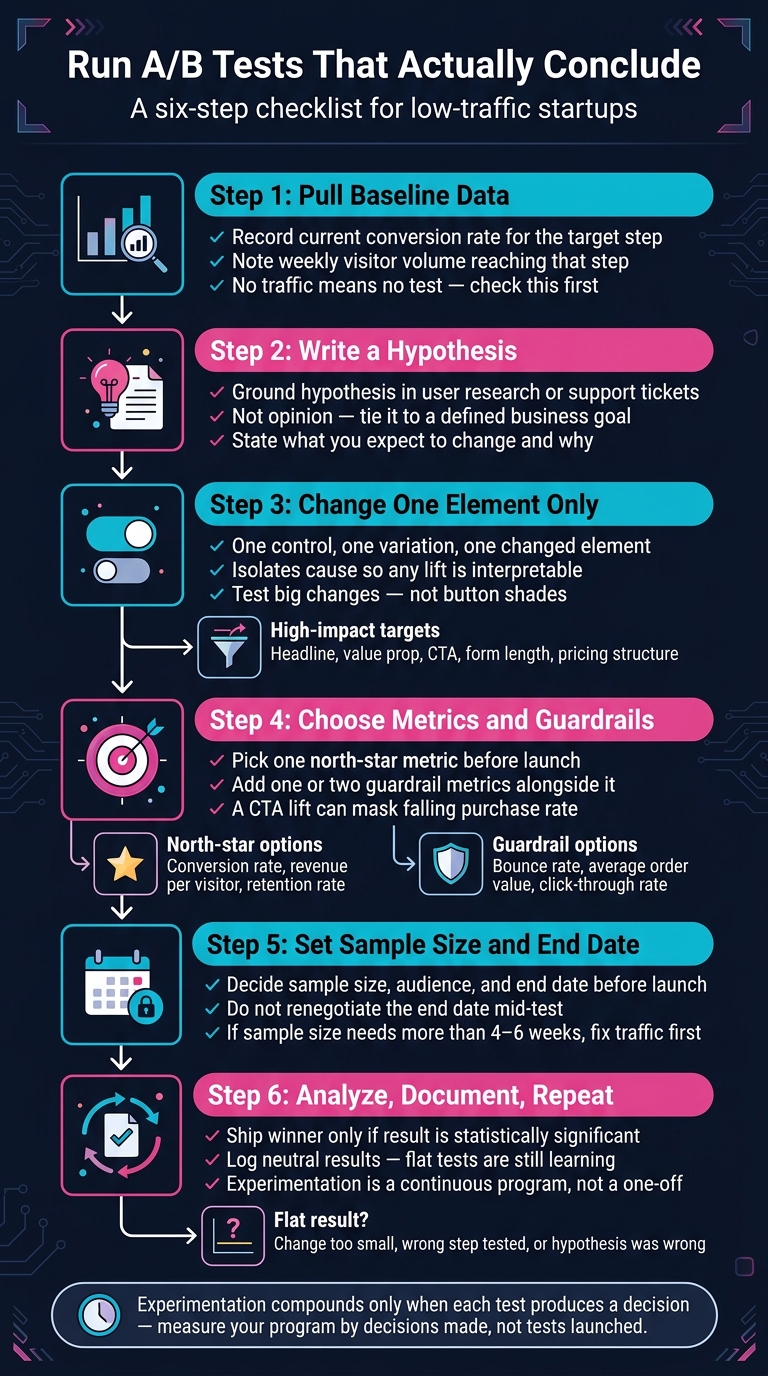
3. Designing one A/B test correctly: a six-step checklist
This merges the setup framework from NN/g[1], Convert's five-step process[2], and Adobe's seven-step sequence[4] into one workflow.
- Pull baseline data for the step you plan to change: current conversion rate and weekly volume.
- Write a hypothesis tied to a defined goal, informed by user research or support tickets — not opinion.[1]
- Change one element, so any lift has an interpretable cause.[4]
- Choose the outcome metric plus guardrails. The common set: conversion rate, click-through rate, bounce rate, retention rate, revenue per user.[1]
- Decide sample size, audience, and end date before launch — and don't renegotiate the end date mid-test.[2][6]
- Analyze, act, document, repeat. Experimentation is a continuous program, not a one-off tactic.[2][4]
Choosing the right test type for your traffic level
| Test type | What it compares | Traffic needed | Best startup use case |
|---|---|---|---|
| A/B test | Control vs. one variation | Lowest | Headline, CTA, form length |
| A/B/n test | Three or more versions | Higher[2] | Only after traffic grows |
| Multivariate test | Combinations of multiple elements | Highest | Rarely justified early |
| Split URL test | Two separate URLs | Moderate | Full page or pricing redesign |
| Multipage / funnel test | Consistent change across a funnel | Moderate to high | Signup or checkout sequence[2] |
Verdict: stay on two-variant tests until a single step reliably receives thousands of visitors per month.
Tooling: why manual testing is not an option
A/B testing can't be done manually — split-testing software is required[2], and Adobe gives the same recommendation over manual methods.[4] Your tool needs to handle three jobs: random assignment, consistent variant assignment per visitor (same person, same version, every visit), and a statistical engine for reading results.
Experimentation is also moving into engineering workflows. Datadog launched Experiments for in-platform A/B and product testing[7], and Google described a fleet-wide system that standardizes experiment assignment across its global service fleet.[8] Founder takeaway: instrument your events properly now, because experimentation is becoming a default engineering capability.
6-Step A/B Testing Framework for Early-Stage Startups
A well-designed test still needs an honest reader.
4. Reading results without fooling yourself
The rule is short: use the winning variation only if the result is statistically significant.[1]
The four mistakes that produce false wins
- Peeking and stopping early before the planned sample size is reached.[1]
- Running during an atypical week — a launch, a Product Hunt spike, a holiday.
- Splitting traffic across too many variants, so nothing reaches significance.[2]
- Celebrating a top-funnel lift while a downstream guardrail quietly drops.[6]
What to do with a flat or losing result
Outcomes come in three flavors: positive, negative, or neutral.[3] A neutral result is still information. Ask which of three things happened: the change was too small to detect, you tested the wrong step, or the hypothesis was wrong. Log the answer and move to the next-highest-priority surface.
Test ideas regardless of how clever or "best practice" they seem, and start small and specific instead of redesigning everything at once.[3]
"If you don't test, you don't know. And guessing in business rarely leads to sustainable growth."
— Alex Birkett, co-founder of Omniscient Digital[2]
Which raises the uncomfortable question: what if your traffic can't support any test at all?
5. When not to A/B test yet: fix traffic first
Here's the threshold. If a page cannot reach the sample size needed to detect a meaningful lift within four to six weeks, testing it is a waste of engineering time. Too few conversions per week means you cannot separate signal from noise[1] — and a test that never concludes still consumes sprint capacity you don't have.
Do these three things instead
- Talk to users. A/B testing sits inside a broader CRO strategy that combines qualitative and quantitative data.[2] Ten customer calls will generate better hypotheses than a month of guessing.
- Ship obvious fixes without testing them. Broken forms, confusing labels, missing pricing information — just fix those.
- Increase qualified traffic so future tests can conclude: backlinks, directory presence, and consistent SEO content.
Building the traffic base with StartupRanking
Sample size is a distribution problem, so solve distribution. A free startup profile on StartupRanking places your company in a global ranking scored by inbound and outbound links plus social engagement — visibility that compounds instead of expiring when an ad budget runs out.
If manual directory submissions are eating your week, that's exactly the work these services remove:
- Booster — 30–120+ directory backlinks without manual submissions.
- Premium Profile — an ad-free page with do-follow links.
- AutoRankr — automated SEO article publishing, so content ships consistently.
- Faster Approval — your listing live within 24 hours instead of waiting in a queue.
The loop closes neatly: more organic traffic shortens test duration, and shorter tests mean more experiments concluded per quarter.
Conclusion: Fewer, better experiments
Five things to carry out of this:
- Startup testing fails on sample size, not creativity.
- Prioritize by traffic × drop-off × effort, and test the highest-traffic drop-off first.
- One control, one variation, one changed element, one north-star metric, guardrails defined in advance.
- Ship a winner only when the result is statistically significant; log neutral results as learning.
- If you can't reach sample size in four to six weeks, invest in traffic and visibility before running the test.
Experimentation compounds only when each test produces a decision — so measure your program by decisions made, not tests launched. And if your funnel is currently too thin to decide anything, list your startup and start building visibility first. The tests will be worth running once people show up.